Introduction
The AWS Certified Solutions Architect – Associate serves as the industry standard for professionals designing distributed systems on the world’s leading cloud platform. This guide is written for software engineers and managers who need to move beyond basic cloud usage toward building resilient, scalable, and cost-effective architectures. In an era dominated by cloud-native development, understanding AWS infrastructure is no longer optional for those in DevOps or platform engineering. By mastering these concepts, you transition from someone who merely writes code to an architect who understands how that code lives and breathes in a production environment. This guide will help you evaluate the certification’s technical depth and determine how it aligns with your long-term career goals in the global IT market. As a Site Reliability Engineer or DevOps lead, having a structured validation of your architectural skills ensures you can lead complex migrations and optimize existing cloud footprints with confidence.
What is the AWS Certified Solutions Architect – Associate?
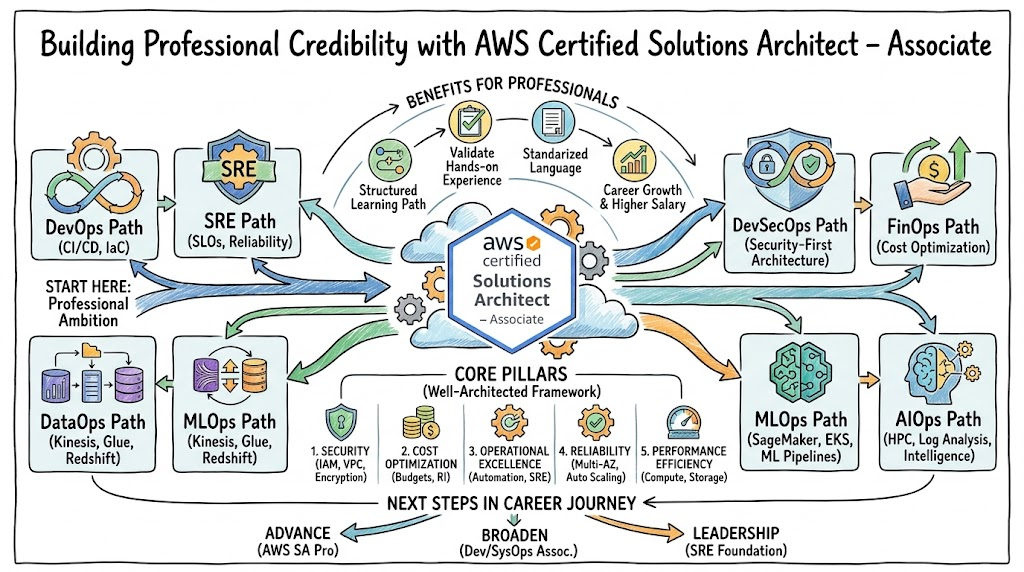
The AWS Certified Solutions Architect – Associate is a mid-level certification designed to validate a professional’s ability to design and deploy functional systems on AWS. It focuses on the core pillars of the AWS Well-Architected Framework: operational excellence, security, reliability, performance efficiency, and cost optimization. Unlike entry-level certs, this exam requires you to solve scenario-based problems, choosing the most efficient service for specific business needs. It bridges the gap between theoretical cloud knowledge and the practical ability to build production-ready environments.
Why it Matters in Today’s Software, Cloud, and Automation Ecosystem
In today’s landscape, automation and infrastructure-as-code are the backbones of any successful delivery pipeline. Without a solid understanding of how AWS services like VPCs, IAM, and EC2 interact, automation scripts become fragile and insecure. This certification ensures that engineers understand the underlying infrastructure they are automating, leading to more stable CI/CD processes and better resource management. As companies move toward serverless and microservices architectures, the ability to select the right compute and storage layers becomes critical for maintaining system uptime and performance.
Why Certifications are Important for Engineers and Managers
For engineers, a certification provides a structured learning path that fills in the gaps left by day-to-day “on the job” learning, ensuring a well-rounded technical foundation. It serves as a benchmark for technical competence that is recognized globally, making it easier to pivot into senior or lead roles. For managers, certifications offer a reliable way to assess the baseline skill level of a team or a potential hire. It ensures that the entire engineering organization speaks the same technical language and adheres to industry best practices when building out company infrastructure.
Why Choose DevOpsSchool?
DevOpsSchool platform offers a practical approach to learning, focusing on real-world labs rather than just theoretical exam prep. The curriculum is owned and managed by industry veterans who understand the nuances of the AWS ecosystem and the specific needs of the DevOps community. By following this structure, learners gain hands-on experience with identity management, networking, and high-availability design that is directly applicable to their daily professional tasks.
Complete AWS Certified Solutions Architect – Associate Certification Table
| Track | Level | Who it’s for | Prerequisites | Skills Covered | Recommended Order |
|---|---|---|---|---|---|
| Cloud Architecture | Associate | Developers, Admins | Basic Cloud Knowledge | VPC, S3, EC2, IAM, ELB | First |
| Cloud Operations | Associate | SysOps, DevOps | Architecture Basics | Monitoring, Deployment | Second |
| Cloud Development | Associate | Software Engineers | Programming Skills | Serverless, SDKs, CI/CD | Third |
| Advanced Networking | Specialty | Network Engineers | Associate Level | Direct Connect, Hybrid Cloud | Fourth |
| Security Specialty | Specialty | Security Analysts | Associate Level | Encryption, KMS, WAF | Fifth |
Detailed Guide for Each AWS Certified Solutions Architect – Associate Certification
What it is
This certification validates your ability to design and deploy secure and robust applications on AWS technologies. It confirms that you can define a solution using architectural design principles based on customer requirements.
Who should take it
This is ideal for individuals with at least one year of hands-on experience designing available, cost-efficient, and fault-tolerant distributed systems on AWS. It is suitable for Developers, Solutions Architects, and Team Leads.
Skills you’ll gain
- Designing resilient architectures using Multi-AZ deployments and Auto Scaling.
- Implementing high-performing storage solutions with S3, EBS, and EFS.
- Securing applications with IAM, Security Groups, and Network ACLs.
- Optimizing costs through reserved instances, spot instances, and lifecycle policies.
Real-world projects you should be able to do
- Build a highly available web application across multiple regions with database replication.
- Design a serverless data processing pipeline using Lambda, S3, and DynamoDB.
- Migrate an on-premise monolithic application to a containerized AWS environment.
Preparation plan
- 7–14 days: Intensive review of AWS Whitepapers and core services like VPC and EC2 for those with heavy experience.
- 30 days: Daily study of 2 hours, completing a full video course and at least three sets of practice exams.
- 60 days: Recommended for beginners; includes hands-on labs for every service and deep dives into the Well-Architected Framework.
Common mistakes
- Overlooking the nuances of VPC peering and transit gateways.
- Confusing the specific use cases for different S3 storage classes.
- Not spending enough time understanding the shared responsibility model for security.
Best next certification after this
- Same-track option: AWS Certified Solutions Architect – Professional.
- Cross-track option: AWS Certified DevOps Engineer – Professional.
- Leadership option: Certified Site Reliability Engineer – Foundation.
Choose Your Learning Path
1. DevOps Path
This path focuses on using AWS architecture to support continuous integration and continuous delivery. Engineers learn to treat infrastructure as code using tools like CloudFormation or Terraform to manage AWS resources. It emphasizes the use of Elastic Beanstalk, ECS, and EKS to create scalable deployment environments. By mastering the Associate level, DevOps professionals ensure their pipelines are backed by a secure and resilient cloud foundation.
2. DevSecOps Path
The DevSecOps path integrates security into the very fabric of the AWS architecture. It goes beyond simple IAM policies to include automated security scanning, secrets management with AWS Secrets Manager, and perimeter protection using WAF. Professionals in this track focus on building “security by design,” ensuring that every architectural decision meets compliance standards. This certification provides the necessary infrastructure context to implement these security controls effectively.
3. SRE Path
For Site Reliability Engineers, the focus is on availability, latency, and performance. Using the Associate certification as a base, an SRE learns to use CloudWatch and X-Ray for deep observability of AWS environments. They design systems that can automatically recover from failures using Route 53 health checks and ELB configurations. This path ensures that the cloud infrastructure meets strict Service Level Objectives (SLOs) through sound architectural choices.
4. AIOps / MLOps Path
This path leverages AWS architecture to host machine learning models and automated operations. It involves understanding how to scale compute resources like SageMaker and how to manage large datasets in S3 or Redshift. MLOps engineers focus on the lifecycle of a model, requiring a solid grasp of AWS networking and storage to ensure data flows efficiently. The Associate certification provides the prerequisite knowledge to manage these complex, data-heavy environments.
5. DataOps Path
DataOps professionals focus on the orchestration of data pipelines and the reliability of data warehouses. This path emphasizes the use of AWS Glue, Athena, and EMR within a well-structured VPC. Understanding AWS architecture allows DataOps engineers to build secure data lakes that are accessible to the right users while maintaining high performance. The certification validates the ability to select the right storage and compute mix for varying data workloads.
6. FinOps Path
FinOps focuses on the financial accountability of the cloud. Professionals in this track use their architectural knowledge to identify wasted resources and implement cost-saving measures like Savings Plans. They learn to design systems that are not only technically sound but also economically optimized. The Associate level teaches the fundamental service costs and billing structures required to manage large-scale cloud budgets effectively.
Role → Recommended AWS Certified Solutions Architect – Associate Certifications
| Role | Recommended Certifications |
|---|---|
| DevOps Engineer | SAA-Associate, DevOps Engineer – Professional |
| SRE | SAA-Associate, Certified Site Reliability Engineer – Foundation |
| Platform Engineer | SAA-Associate, Advanced Networking – Specialty |
| Cloud Engineer | SAA-Associate, SysOps Administrator – Associate |
| Security Engineer | SAA-Associate, Security – Specialty |
| Data Engineer | SAA-Associate, Data Engineering – Associate |
| FinOps Practitioner | SAA-Associate, Cloud Practitioner |
| Engineering Manager | SAA-Associate, Certified Site Reliability Engineer – Foundation |
Next Certifications to Take After AWS Certified Solutions Architect – Associate
Same Track Progression
The logical next step is the AWS Certified Solutions Architect – Professional. This exam moves from architectural design to complex, multi-tier solutions and multi-account strategies. It requires a deeper understanding of organizational governance, complex migrations, and advanced cost-optimization across thousands of resources.
Cross-Track Expansion
If you are moving into the automation space, the AWS Certified DevOps Engineer – Professional is the best choice. This expands your architectural knowledge into the realm of automated provisioning, monitoring, and logging. It focuses on the “how” of deployment, complementing the “what” of architectural design.
Leadership & Management Track
For those moving into technical leadership, the Certified Site Reliability Engineer – Foundation is highly recommended. This track focuses on the culture and practices of reliability, managing technical debt, and leading teams through incident response. It combines technical architecture with operational excellence and people management.
Training & Certification Support Providers for AWS Certified Solutions Architect – Associate
Top Training Institutions
- DevOpsSchool DevOpsSchool is a globally recognized leader in DevOps and cloud-native training, offering a robust, lab-centric curriculum that emphasizes hands-on mastery of tools and architectural patterns. Their programs are designed by industry veterans to bridge the gap between technical theory and production-grade implementation, making them a preferred choice for professionals aiming for certifications like the AWS Solutions Architect Associate.
- Cotocus Cotocus specializes in high-end technical consulting and specialized training bootcamps focused on cloud migrations and infrastructure modernization. They provide deep-dive mentorship for engineers and managers, helping them navigate complex architectural designs and enterprise-level deployment strategies with a focus on real-world scalability.
- Scmgalaxy Scmgalaxy serves as one of the largest community-driven knowledge hubs in the DevOps ecosystem, providing a vast repository of technical documentation, tutorials, and certification resources. It is an essential platform for professionals seeking to stay updated on the latest industry trends, toolchains, and architectural best practices across the global IT market.
- BestDevOps BestDevOps focuses on delivering intensive, high-impact training modules that help technical professionals quickly gain expertise in the core components of the cloud and DevOps landscape. Their curriculum is highly structured to help engineers move from basic cloud literacy to professional-level competency in building and managing secure cloud environments.
- Devsecopsschool.com Devsecopsschool.com is dedicated to the critical intersection of security and development, providing specialized training on integrating automated security guardrails into the CI/CD pipeline. They focus on “security-as-code” and “privacy-by-design,” ensuring that architects and developers can build and maintain compliant, secure-by-default cloud-native systems.
- Aiopsschool.com Aiopsschool.com leads the way in educating the next generation of engineers on the application of artificial intelligence and machine learning to IT operations. Their training covers the orchestration of intelligent infrastructure, automated incident response, and the use of AI-driven analytics to maintain high-performance, self-healing cloud systems.
- Dataopsschool.com Dataopsschool.com focuses on the reliability, security, and orchestration of the modern data lifecycle within the cloud. They offer specialized courses on data engineering, analytics architecture, and data lake management, ensuring that data flows efficiently and securely across complex enterprise environments.
- Finopsschool.com Finopsschool.com addresses the growing demand for cloud financial management, teaching professionals how to optimize costs without sacrificing performance. Their curriculum helps architects and managers master the art of cost-aware design, resource allocation, and the financial governance required to manage large-scale cloud budgets effectively.
- Sreschool.com Sreschool.com provides targeted education focused on the principles of Site Reliability Engineering, including observability, availability, and incident management. Their programs help engineers master the cultural and technical practices required to maintain “always-on” systems, emphasizing the management of error budgets and system uptime in production environments.
Frequently Asked Questions (General)
1. How long does it take to prepare for the Associate exam?
Most professionals with some IT background require 30 to 60 days of consistent study to pass.
2. Is there a prerequisite for the Solutions Architect Associate?
There are no formal prerequisites, though having basic cloud knowledge or a Practitioner cert helps.
3. How long is the AWS certification valid?
The certification is valid for three years, after which you must recertify or move to a Professional level.
4. What is the passing score for the exam?
The passing score is 720 out of 1000, using a scaled scoring model.
5. Are the questions multiple-choice or lab-based?
The exam consists of multiple-choice and multiple-response questions, often based on complex scenarios.
6. Can I take the exam online from home?
Yes, AWS offers online proctored exams through Pearson VUE.
7. How much does the exam cost?
The Associate level exam currently costs 150 USD plus applicable taxes.
8. Does this certification help in getting a job in India?
Yes, AWS is the leading cloud provider in India, and this cert is highly valued by top MNCs and startups.
9. Is the Solutions Architect Associate harder than the Developer Associate?
It is generally considered broader in scope as it covers networking and storage more deeply than the Developer exam.
10. What happens if I fail the exam?
You must wait 14 days before you are eligible to retake the exam.
11. Does AWS provide free study materials?
Yes, AWS offers free digital training through AWS Skill Builder and various official whitepapers.
12. Is coding required for this certification?
Extensive coding is not required, but understanding basic JSON/YAML for policies and templates is very helpful.
FAQs on AWS Certified Solutions Architect – Associate
1. Which AWS services are emphasized the most in the Associate exam?
Expect a heavy focus on VPC, EC2, S3, IAM, and RDS, as these form the core of most architectures.
2. How does this cert differ from the SysOps Administrator Associate?
While this cert focuses on design and “building,” SysOps focuses more on deployment, management, and operations.
3. Is serverless architecture covered in the SAA-C03 exam?
Yes, knowledge of Lambda, API Gateway, and DynamoDB is essential for modern architectural questions.
4. How important is the Well-Architected Framework for this exam?
It is critical; many questions are specifically designed to test your ability to apply the five pillars to scenarios.
5. Do I need to know about hybrid cloud connectivity?
Yes, you should understand how Direct Connect and VPNs connect on-premise data centers to AWS.
6. Are databases like Aurora and Redshift covered?
Yes, you need to know when to use RDS versus Aurora, and when a data warehouse like Redshift is appropriate.
7. Is there a focus on global application delivery?
Yes, understanding CloudFront, Route 53 latency routing, and Global Accelerator is necessary for high-score performance.
8. How detailed is the networking portion of the exam?
You must be comfortable with CIDR blocks, subnets, route tables, and the difference between NAT Gateways and NAT Instances.
Conclusion
The AWS Certified Solutions Architect – Associate is one of the most practical investments you can make in your career. It is not just a piece of paper; the process of studying for it forces you to think like an architect. You stop looking at services in isolation and start seeing how they connect to solve business problems. Whether you are a developer looking to understand the environment your code runs in, or a manager trying to guide a team through a digital transformation, this certification provides the clarity and technical vocabulary needed to succeed. It remains a foundational requirement for any serious cloud professional in today’s competitive global market.