Introduction
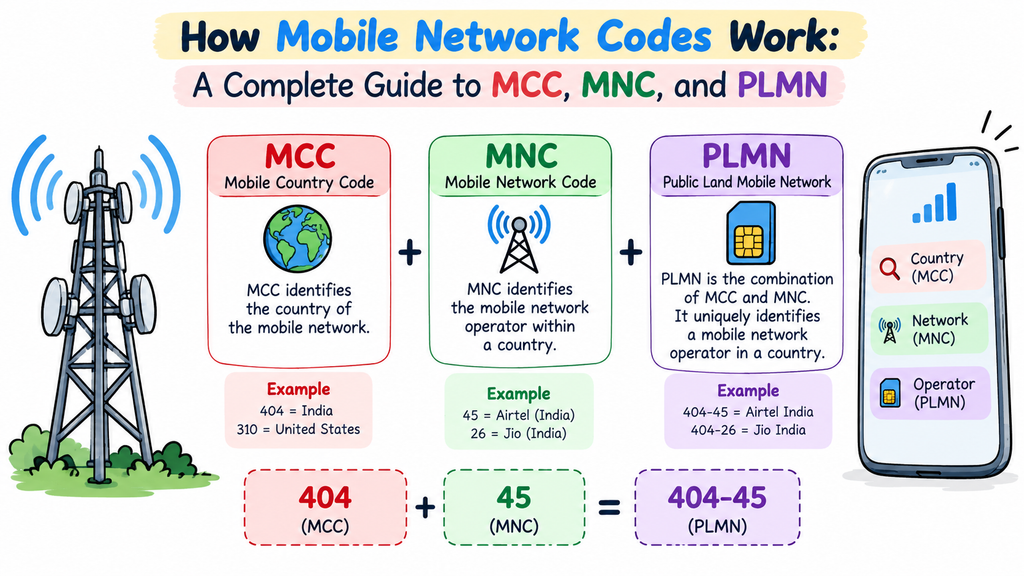
Every mobile network needs a reliable way to identify itself. Mobile devices and telecom systems use network identifiers to recognize networks and process related information. Three important terms help explain this process: Mobile Country Code (MCC), Mobile Network Code (MNC), and Public Land Mobile Network (PLMN).
These identifiers play an important role in telecom databases, mobile network research, and connectivity analysis. They also help researchers understand how operators and their networks appear in technical records. However, each identifier serves a different purpose, so users must understand the differences before comparing network information.
For travelers, developers, telecom professionals, and eSIM users, learning these terms can make network research easier. It can also prevent common mistakes when checking operator records or researching connectivity providers. This guide explains how the codes work, how they relate to one another, and how to interpret them responsibly.
Why Mobile Networks Need Unique Identifiers
Telecommunications systems handle information from many mobile networks. Without a consistent identification system, distinguishing one network from another would become difficult. Standardized identifiers help systems organize and interpret network information.
Mobile network identifiers also support telecom research and database management. Researchers can use them to examine network assignments, compare records, and understand relationships between operators. However, they must combine code information with reliable records to reach accurate conclusions.
A network identifier provides technical information. It does not explain every part of a company’s business model or prove that a service works in a particular location.
What Is a Mobile Country Code?
A Mobile Country Code (MCC) is a three-digit identifier used within mobile network identification systems. It provides country or geographical context for a mobile network.
Telecom databases use MCC values to organize network information. Researchers can examine an MCC alongside other identifiers to understand which geographical numbering context applies to a network record.
An MCC alone does not identify a specific mobile operator. Several network records may share the same country context while using different network codes. Therefore, researchers need additional information to identify the relevant network.
When checking an MCC, preserve all three digits. Avoid changing its format when moving information between spreadsheets, databases, and applications.
What Is a Mobile Network Code?
A Mobile Network Code (MNC) identifies a mobile network within the context established by an MCC. Depending on the applicable numbering plan, an MNC may contain two or three digits.
The MNC helps distinguish networks that operate within the same geographical numbering context. However, researchers should not interpret an MNC without checking its associated MCC and assignment details.
For example, imagine a database containing an MCC and an MNC in separate fields. A researcher can examine the combined values to investigate the relevant network assignment. The researcher must still confirm the record through an appropriate source.
MNC formatting matters because leading zeros can form part of the identifier. Storing the code as ordinary numeric data may remove those zeros and create matching problems.
What Does PLMN Mean?
PLMN stands for Public Land Mobile Network. It describes a public mobile network that provides services such as mobile voice and data connectivity.
In common network identification contexts, a PLMN identity combines an MCC and an MNC. These values work together to identify a mobile network within the relevant numbering system.
A PLMN identity differs from a consumer-facing mobile brand. A company may operate several brands, while another provider may sell mobile services using an existing operator’s network.
This distinction matters when researchers compare telecom directories. A brand name, network assignment, and connectivity provider may describe different parts of the same service arrangement.
MCC, MNC, and PLMN: Understanding the Differences
Although these terms work together, each serves a different purpose. Understanding their roles makes telecom records easier to interpret.
| Identifier | Full Name | Main Role | Typical Format | What It Does Not Confirm |
|---|---|---|---|---|
| MCC | Mobile Country Code | Provides country or geographical numbering context | Three digits | The identity of a specific network by itself |
| MNC | Mobile Network Code | Identifies a network within an MCC context | Two or three digits, depending on the numbering plan | Complete network details without the associated context |
| PLMN | Public Land Mobile Network | Describes a public mobile network; its identity commonly combines MCC and MNC | MCC and MNC together | Coverage, roaming eligibility, or service compatibility |
The simplest way to understand the relationship is to consider the scope of each identifier. The MCC provides geographical context, the MNC identifies a network within that context, and the PLMN describes the public mobile network.
These identifiers help people understand network identity. They do not replace current operator information or service-specific checks.
How MCC, MNC, and PLMN Work Together
Mobile network identification relies on interpreting related values correctly. An MCC provides the geographical context, while the MNC identifies the relevant network within that context.
Consider a hypothetical telecom record containing an MCC and an MNC. A researcher can use these values to search for a corresponding network assignment. The combined information helps narrow the search to a particular network identity.
The researcher should then compare the result with a reliable telecom reference. If the task involves a commercial service, the researcher should also confirm the operator’s identity and service details.
A practical research process follows these steps:
- Record the MCC. Preserve the original three-digit value.
- Record the MNC. Keep the original digit length and any leading zeros.
- Interpret the combined identity. Use the appropriate conventions for the relevant network identification system.
- Verify the assignment. Consult a relevant regulator, recognized technical reference, or other authoritative source.
- Identify the organization. Determine whether the record refers to an operator, brand, virtual operator, or reseller.
- Check the service separately. Review coverage, roaming conditions, and compatibility when these details matter.
This approach separates network identification from assumptions about commercial services.
Where Telecom Professionals Use Network Identifiers
MCC, MNC, and PLMN information supports several research and operational tasks. The exact use depends on the system and the question being investigated.
Network Identification and Analysis
Telecom researchers use identifiers to distinguish network records and organize technical information. Consistent identifiers help analysts compare records across different data sources.
However, researchers must check the meaning and scope of each record. Similar names do not necessarily indicate the same network or company.
Telecom Database Management
A telecom directory may contain operator names, network codes, geographical information, and notes about business relationships. Accurate identifiers help maintain consistent records.
Database teams should preserve the source and verification date for important assignments. This practice makes it easier to investigate conflicts and update outdated information.
Roaming Research
International roaming allows eligible mobile users to access partner networks outside their home network’s usual service area. Network identifiers can help researchers examine which networks appear in relevant records.
However, an MCC or MNC does not prove that a subscriber can roam on a network. Roaming access may depend on agreements, subscription terms, account settings, device support, and local conditions.
Users should confirm roaming availability with the provider before relying on a particular network while traveling.
eSIM Research
An eSIM allows a compatible device to use a mobile subscription without inserting a removable SIM card. People researching eSIM plans may want to know which networks support a service in their destination.
MCC and MNC information can help users investigate network identities. Still, these codes alone cannot confirm which network an eSIM plan will use or whether the plan will work on a particular device.
Before choosing an eSIM plan, check supported destinations, available networks, data limits, activation requirements, and device compatibility.
Technical Research and Reporting
Analysts may use network identifiers to classify records, investigate changes, and compare information from different sources. Reliable results depend on consistent formatting and careful verification.
When a report includes uncertain information, label that uncertainty clearly. This helps readers distinguish confirmed assignments from assumptions or outdated records.
Understanding Operators, Brands, and Connectivity Providers
One of the most common problems in telecom research involves confusing a service provider with the network operator. These organizations can have different roles, even when customers see only one brand.
Mobile Network Operators
A mobile network operator (MNO) operates mobile network infrastructure and provides mobile communication services under the applicable regulatory framework.
Researchers should verify the operator’s identity and the network assignments associated with it. An official company name may differ from the brand customers recognize.
Mobile Virtual Network Operators
A mobile virtual network operator (MVNO) sells mobile services using infrastructure or wholesale access from another operator. It does not necessarily operate a complete independent radio network.
An MVNO may have its own plans, prices, customer support, and branding. Its relationship with the underlying operator depends on the specific arrangement.
Researchers should not assume that every MVNO has a separate MCC/MNC assignment. They should verify the relevant records instead.
Consumer Mobile Brands
A consumer brand is the name customers see when they buy or use a mobile service. The brand may belong to an infrastructure-owning operator or another company.
The brand name alone does not reveal the exact network identity used by every service. Researchers should examine the underlying operator relationship before drawing conclusions.
eSIM Providers and Resellers
Some companies sell eSIM plans that use networks operated by other businesses. These companies may focus on plan distribution, activation, customer support, or connectivity services.
An eSIM provider should not automatically be treated as the underlying mobile network operator. Users should check which networks a plan supports and what conditions apply.
| Organization Type | Main Function | Key Research Question |
|---|---|---|
| Mobile network operator | Operates mobile network infrastructure and services | Which network assignments belong to this operator? |
| MVNO | Sells mobile services using another operator’s infrastructure or wholesale access | Which underlying network supports the service? |
| Consumer brand | Markets mobile services to customers | Which company and network support the brand? |
| eSIM provider | Offers eSIM connectivity plans | Which networks and destinations does the plan support? |
| Reseller | Distributes services supplied by another provider | Who supplies the underlying service? |
These categories can overlap. A reliable telecom record should explain the relationship rather than force every company into a single category.
How to Verify MCC and MNC Information
Reliable verification helps prevent errors in technical reports, research projects, and telecom databases. A code found in one directory should not automatically become the final authority for every use.
Start With the Original Code Format
Record MCC and MNC values separately. Preserve leading zeros and original digit lengths so that the data remains consistent.
When working with spreadsheets, consider storing codes as text. This prevents software from removing leading zeros or changing the displayed format.
Consult an Authoritative Source
Use the relevant national regulator, recognized standards documentation, or another authoritative telecom reference. Choose a source that supports the specific claim you need to verify.
For example, an assignment record may help establish which organization received a code. It may not prove that a particular consumer service currently operates or supports roaming.
Compare Operator Names Carefully
Different sources may use a legal company name, a trading name, or a consumer brand. These names may refer to related but distinct entities.
Check the relationship before combining records. Do not assume that similar names prove common ownership or identical network operations.
Investigate Conflicting Information
If two directories disagree, compare their sources, dates, definitions, and scope. One record may be outdated, while another may describe a different type of entity.
If the evidence does not resolve the conflict, mark the information as unverified. Avoid choosing a value simply because it appears more often online.
Keep a Verification Record
A useful telecom database should record where important information came from and when someone checked it. This gives future researchers a way to assess reliability.
Depending on the project, useful fields may include:
- MCC and MNC values.
- Combined PLMN identity, where relevant.
- Operator or organization name.
- Country or geographical context.
- Source of the assignment information.
- Verification date.
- Notes about uncertainty or naming differences.
The best database structure depends on the task. Consistency matters more than adding unnecessary fields.
Common Mistakes in Mobile Network Research
Small data errors can lead to incorrect network matches. Researchers can avoid many problems by checking the identifier format and the meaning of each record.
Treating MCC as a Complete Network Identifier
An MCC provides geographical context but does not identify a specific mobile network on its own. Researchers need additional information to identify the network.
Better approach: Check the associated MNC and verify the combined record.
Removing Leading Zeros
Converting identifiers into ordinary numbers may remove leading zeros. This can cause records to mismatch during searches or data comparisons.
Better approach: Preserve the original text format and digit length.
Assuming Every Provider Owns a Network
An eSIM provider, reseller, or MVNO may rely on another operator’s infrastructure. Its public brand does not necessarily identify the underlying network.
Better approach: Verify the business relationship and network assignment separately.
Confusing Assignment With Availability
A code assignment does not prove that a network offers service in a particular location or supports a particular customer.
Better approach: Check current coverage and service conditions with an appropriate provider.
Using Outdated Records Without Checking
Company names, assignments, and commercial arrangements may change. Old information may remain useful for historical research but may not describe current services.
Better approach: Record verification dates and recheck important details before making decisions.
What Network Identifiers Cannot Tell You
MCC, MNC, and PLMN information answers specific questions about network identity. It cannot answer every question about mobile connectivity.
They Do Not Guarantee Coverage
An identifier does not establish that a network provides service at a particular address or destination. Coverage depends on the network’s actual deployment and local conditions.
They Do Not Guarantee Device Compatibility
A device must support the relevant network technologies and frequency bands. eSIM use may also depend on device support, regional variants, and carrier restrictions.
They Do Not Confirm Roaming Agreements
A network identifier cannot establish whether two operators have a roaming agreement or whether a subscriber’s plan includes roaming access.
They Do Not Explain Every Commercial Relationship
A code record does not necessarily reveal ownership, wholesale agreements, reseller arrangements, or the exact services a company sells.
For these questions, users need additional evidence from operators, regulators, providers, or other suitable sources.
How a Telecom Directory Can Support Research
A global telecom directory can help users explore network operators and identifiers in a structured way. It can serve as a starting point for research into MCC, MNC, and PLMN information.
eSIMGlobo focuses on global telecom information, including mobile network operators and network identifiers. This area of research can help developers, analysts, travelers, and eSIM users understand telecom records.
When using any directory, first determine what each entry represents. Check whether the record refers to a network assignment, an operator, a brand, or a connectivity provider. Then confirm important information against an appropriate source.
A directory works best as a research aid, not as automatic proof that a service will work. For decisions involving coverage, roaming, or device compatibility, users should check current service details separately.
Frequently Asked Questions
1. What is an MCC in mobile networks?
MCC means Mobile Country Code. It is a three-digit identifier that provides country or geographical context within mobile network identification systems. Researchers use it alongside other information to identify a network record.
2. What is an MNC?
MNC stands for Mobile Network Code. It identifies a network within an MCC context. Its length can be two or three digits, depending on the applicable numbering plan.
3. What does PLMN stand for?
PLMN stands for Public Land Mobile Network. In common identification contexts, its identity combines an MCC and an MNC. It describes a public mobile network but does not confirm every detail about its services.
4. How do MCC and MNC differ?
An MCC provides geographical numbering context, while an MNC identifies a network within that context. Researchers usually need both values to interpret the network identity correctly.
5. Does every mobile provider have a unique MNC?
Not necessarily. A provider may operate as an MVNO, brand, or reseller and use another operator’s network. Researchers should check the actual assignment and business arrangement instead of making assumptions.
6. Can MCC and MNC codes confirm roaming availability?
No. These codes help identify networks, but they do not prove roaming access. Availability may depend on operator agreements, subscription terms, account settings, device support, and local conditions.
7. Can I use network codes when researching eSIM plans?
Yes. Network identifiers can help you investigate the networks associated with a service. You should also check destination coverage, plan restrictions, data allowances, activation rules, and device compatibility.
8. Why do directories sometimes show different operator names?
Sources may use legal entity names, trading names, or consumer brands. They may also contain records from different dates. Compare the source and context before deciding whether the entries refer to the same organization.
9. Why should I preserve leading zeros in MCC and MNC records?
Leading zeros can form part of the correct identifier format. Removing them may cause database mismatches or incorrect comparisons. Store codes in a way that preserves their original representation.
10. How can I check whether a network code is correct?
Consult the relevant national regulator, recognized standards documentation, or another authoritative telecom source. Record the source and verification date, then compare the assignment with official operator information when necessary.
Conclusion
Mobile network identifiers help telecom systems and researchers organize network information. MCC provides geographical context, MNC identifies a network within that context, and PLMN describes a public mobile network.
Accurate research requires more than reading these codes. Researchers should preserve the original format, verify assignments, distinguish operators from brands and resellers, and check service conditions separately. These habits help prevent mistakes and support more reliable telecom records.
For people researching global operators and network identifiers, eSIMGlobo offers a relevant starting point. Combining directory information with authoritative records and current service details leads to better-informed conclusions.