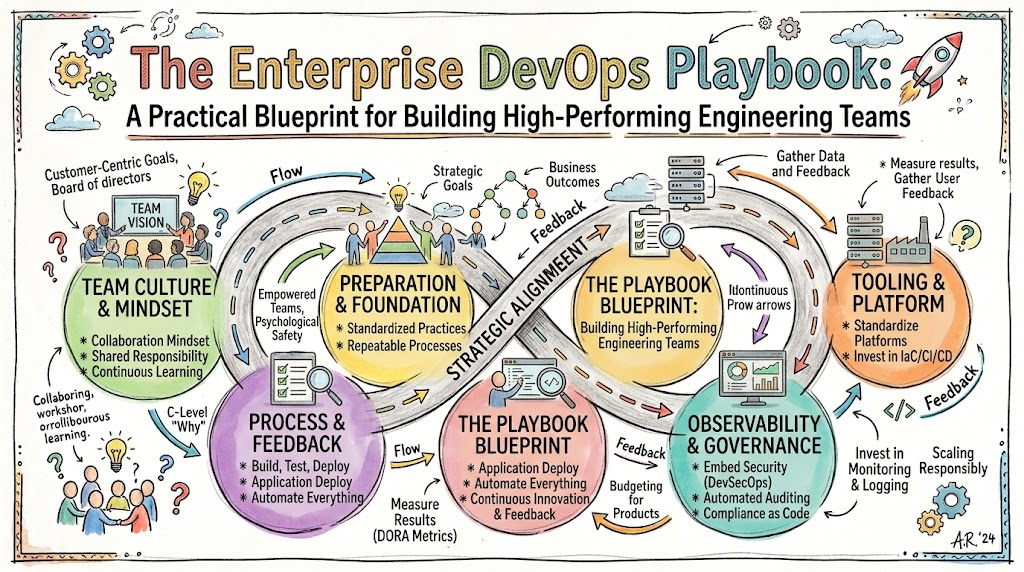
Introduction
Technology leaders often assume that adopting Kubernetes, implementing CI/CD pipelines, or moving applications to the cloud automatically makes an organization “DevOps-ready.” In reality, successful DevOps transformation has very little to do with individual tools. It is about creating an engineering culture where software can move from an idea to production rapidly, safely, and repeatedly.
Organizations that consistently deliver high-quality software have one thing in common—they build systems that encourage collaboration, automation, observability, continuous improvement, and shared ownership. These principles reduce operational complexity, improve deployment confidence, and help engineering teams respond quickly to changing business requirements.
This tutorial presents a practical enterprise blueprint for organizations planning to modernize their software delivery lifecycle. Instead of discussing tools in isolation, it explains how each component contributes to a scalable engineering ecosystem and how experienced DevOps trainers and consultants help teams adopt these practices effectively.
Looking Beyond DevOps Tools
One of the most common misconceptions is that DevOps is simply a combination of Jenkins, Docker, Kubernetes, Terraform, Git, and cloud services. While these technologies are important, they are only enablers of a broader engineering methodology.
Imagine two organizations using exactly the same technology stack. One releases software several times a day with minimal downtime, while the other struggles with failed deployments and production incidents. The difference lies in processes, collaboration, governance, automation, and engineering discipline—not the tools themselves.
A successful DevOps transformation starts with understanding how software flows through the organization, where bottlenecks exist, and how automation can remove repetitive work.
Assessing Engineering Maturity
Before introducing new technologies, organizations should evaluate their current engineering practices. This assessment helps identify areas where improvements will have the greatest impact.
Key questions include:
- How frequently are applications deployed?
- How long does it take to recover from failures?
- Which deployment activities remain manual?
- Are environments consistent across development, testing, and production?
- How is infrastructure provisioned?
- What monitoring and alerting systems are currently in place?
- How are security checks integrated into the development lifecycle?
- Are teams collaborating effectively across development, operations, and security?
The answers provide a baseline for creating a realistic modernization roadmap.
Designing a Modern DevOps Architecture
Modern software delivery relies on several interconnected layers rather than a single platform.
A typical enterprise architecture includes:
- Source code management
- Continuous Integration
- Automated testing
- Artifact repositories
- Containerization
- Kubernetes orchestration
- Infrastructure as Code
- Configuration management
- Cloud platforms
- Monitoring and observability
- Security automation
- Incident management
- Continuous optimization
Each layer supports the next, creating a repeatable and reliable software delivery process.
Building an Effective CI/CD Pipeline
Continuous Integration and Continuous Delivery form the backbone of DevOps automation.
A mature CI/CD pipeline typically includes:
- Source code commit
- Automated build
- Static code analysis
- Unit testing
- Security scanning
- Container image creation
- Artifact publishing
- Infrastructure validation
- Deployment to testing
- Integration testing
- Performance testing
- Production deployment
- Post-deployment monitoring
Automation at each stage minimizes human error and ensures consistent deployments.
Containerization as the Foundation of Cloud-Native Applications
Containers package applications together with their dependencies, ensuring consistent execution across environments.
Benefits include:
- Faster deployments
- Environment consistency
- Improved resource utilization
- Simplified scaling
- Easier rollback
- Better portability
- Reduced infrastructure conflicts
Containerization is often the first major step toward adopting Kubernetes and cloud-native architectures.
Why Kubernetes Has Become the Industry Standard
As organizations deploy hundreds or thousands of containers, manual management becomes impractical. Kubernetes addresses this challenge by automating deployment, scaling, networking, and recovery.
Key Kubernetes capabilities include:
- Self-healing workloads
- Automatic scaling
- Rolling updates
- Service discovery
- Load balancing
- Resource optimization
- Secret management
- High availability
- Multi-cloud portability
However, successful Kubernetes adoption requires thoughtful planning, governance, and operational expertise.
Infrastructure as Code
Infrastructure should be managed using version-controlled code rather than manual configuration.
Infrastructure as Code enables organizations to:
- Reproduce environments consistently
- Track infrastructure changes
- Simplify disaster recovery
- Automate provisioning
- Reduce configuration drift
- Improve collaboration
This approach transforms infrastructure management into a repeatable engineering process.
Configuration Management
Provisioning infrastructure is only one part of automation. Systems must also be configured consistently.
Configuration management solutions help organizations:
- Install software automatically
- Enforce security baselines
- Maintain configuration consistency
- Automate updates
- Standardize environments
Together with Infrastructure as Code, configuration management creates reliable infrastructure automation.
Cloud Strategy
Cloud adoption should align with business objectives rather than technology trends.
Organizations should evaluate:
- Scalability requirements
- Compliance obligations
- Cost optimization
- Disaster recovery
- Geographic distribution
- Performance expectations
- Vendor strategy
Selecting the right cloud architecture requires balancing flexibility, governance, and operational efficiency.
Observability
Monitoring alone is no longer sufficient for complex distributed systems.
Modern observability combines:
- Metrics
- Logs
- Distributed traces
- Event correlation
- Application performance monitoring
- Infrastructure monitoring
- Synthetic testing
Together, these capabilities help engineering teams identify and resolve issues before they affect users.
Reliability Engineering
Site Reliability Engineering introduces engineering practices that improve service reliability while enabling rapid innovation.
Important concepts include:
- Service Level Indicators (SLIs)
- Service Level Objectives (SLOs)
- Error budgets
- Incident response
- Capacity planning
- Reliability automation
- Performance optimization
Reliability becomes a measurable engineering objective rather than an operational afterthought.
Integrating Security into DevOps
Security should be incorporated throughout the software development lifecycle rather than added immediately before release.
Modern DevSecOps practices include:
- Secure coding standards
- Dependency scanning
- Infrastructure scanning
- Container image analysis
- Secret management
- Identity and access controls
- Compliance automation
- Continuous vulnerability assessment
Early security integration reduces risk while maintaining deployment velocity.
Platform Engineering
As engineering organizations grow, maintaining consistent developer experiences becomes increasingly difficult.
Platform Engineering addresses this challenge by creating standardized internal platforms that provide:
- Self-service infrastructure
- Deployment templates
- Security guardrails
- CI/CD templates
- Monitoring integration
- Policy automation
This enables developers to focus on building applications instead of managing infrastructure.
Measuring Success
Transformation efforts should be evaluated using measurable outcomes rather than technology adoption alone.
Useful metrics include:
- Deployment frequency
- Lead time for changes
- Change failure rate
- Mean Time to Recovery (MTTR)
- Infrastructure provisioning time
- Release success rate
- Application availability
- Customer satisfaction
- Operational cost savings
Tracking these metrics helps organizations continuously improve their engineering processes.
The Role of Training and Consulting
Technology investments deliver value only when teams understand how to apply them effectively.
Experienced DevOps trainers and consultants help organizations by:
- Assessing current maturity
- Designing transformation roadmaps
- Delivering hands-on workshops
- Mentoring engineering teams
- Standardizing best practices
- Optimizing cloud architectures
- Improving automation
- Strengthening reliability and security
Their practical experience accelerates adoption and reduces implementation risks.
Enterprise DevOps Transformation Checklist
Before beginning a transformation initiative, organizations should ensure they have:
- Defined business objectives
- Executive sponsorship
- Cross-functional collaboration
- Version-controlled infrastructure
- Automated CI/CD pipelines
- Containerization strategy
- Kubernetes governance
- Security integration
- Monitoring and observability
- Incident response processes
- Continuous training plans
- Success metrics
Common Mistakes to Avoid
Organizations often encounter similar challenges during DevOps adoption:
- Treating DevOps as a tooling project
- Automating inefficient processes
- Ignoring organizational culture
- Delaying security integration
- Skipping documentation
- Neglecting monitoring
- Overcomplicating Kubernetes deployments
- Failing to measure outcomes
- Underestimating training requirements
Recognizing these pitfalls early helps create a smoother transformation journey.
Final Thoughts
Enterprise DevOps transformation is not a destination but a continuous process of improvement. Organizations that combine automation, collaboration, cloud-native technologies, observability, reliability engineering, and continuous learning are better positioned to deliver software quickly, securely, and consistently.
Whether modernizing legacy infrastructure, implementing Kubernetes, improving CI/CD pipelines, strengthening security, or building an internal developer platform, success depends on a structured strategy supported by experienced guidance and ongoing skill development.
By approaching DevOps as an organizational capability rather than a collection of tools, businesses can create resilient engineering systems that support innovation, scalability, and long-term growth.