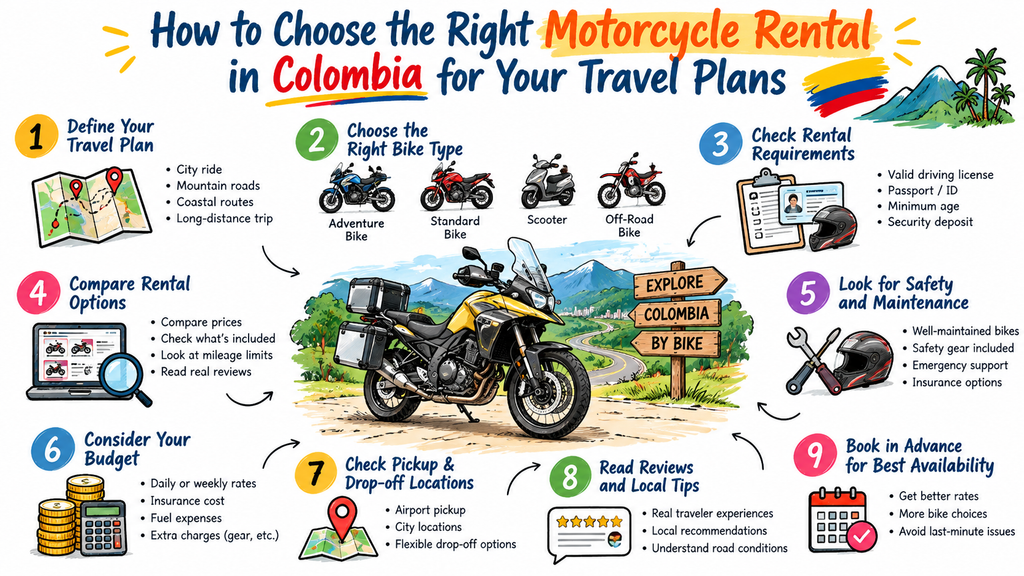
Introduction
Colombia offers many ways to explore its cities, mountain regions, coastal destinations, and countryside. A motorcycle can provide flexibility for travelers who want to explore beyond busy tourist areas. However, the right rental depends on more than the daily price. Your riding experience, travel route, luggage, weather, and rental conditions all affect the decision.
A motorcycle that works well for Medellín’s urban streets may not suit a long journey through mountain roads. Similarly, a lightweight commuter bike may be practical for short trips but less comfortable for several hours of riding.
Understanding your options before booking can help you avoid unnecessary costs and choose a vehicle that fits your plans. This guide explains how to compare motorcycle rental options in Colombia, assess rental requirements, prepare for local roads, and make informed decisions before starting your journey.
1. Understand Your Travel Plans Before Choosing a Motorcycle
Start by deciding how you intend to use the motorcycle. Your route and travel style should determine the type of vehicle you rent.
For example, a traveler staying in Medellín might need a motorcycle for short trips between neighborhoods and nearby attractions. Someone planning a longer journey through the Colombian countryside may need better suspension, more comfortable seating, and enough luggage capacity.
Consider these questions before comparing rental options:
- How many days will you need the motorcycle?
- Will you mainly ride within a city or travel between destinations?
- Will you carry a passenger?
- How much luggage will you bring?
- Do you have experience riding on mountain roads?
- Will you travel during periods of frequent rain?
- Do you need a motorcycle with manual gears or an automatic scooter?
Your answers will help narrow the available choices. They will also make it easier to compare rental offers fairly.
Avoid choosing a motorcycle simply because it looks powerful or attractive. A manageable vehicle that suits your route often provides a better experience than a larger motorcycle that exceeds your needs.
2. Compare Different Types of Rental Motorcycles
Rental providers may offer different motorcycle categories depending on their location and fleet. Confirm the exact models and specifications before booking.
Commuter Motorcycles
Commuter motorcycles generally suit short urban trips and everyday transportation. Their practical design can make them a reasonable option for riders who prioritize straightforward handling and lower operating demands.
Consider this category when you plan to:
- Explore a city over several days.
- Travel between nearby neighborhoods.
- Make short trips without carrying much luggage.
- Keep fuel consumption and rental expenses manageable.
However, smaller commuter motorcycles may offer limited comfort on long journeys. Their performance, luggage capacity, and suitability for steep roads vary by model.
Adventure Motorcycles
Adventure motorcycles may suit experienced riders planning longer journeys across varied road conditions.
Depending on the model, they can offer upright seating, greater suspension travel, and space for travel equipment. These features may help on some uneven roads, but they do not make every route suitable for every motorcycle.
Consider an adventure motorcycle if your itinerary includes longer distances, changing elevations, or rural destinations. Check the bike’s weight, seat height, ground clearance, luggage arrangements, and handling before committing.
A heavy adventure motorcycle can become difficult to manage in tight city traffic or when parking on uneven ground. Riders should choose a model they can control confidently.
Touring Motorcycles
Touring motorcycles focus on comfort during longer rides. Some models provide wind protection, comfortable seats, and luggage storage.
They may suit travelers planning extended road journeys with fewer stops. However, their size and weight can make them less convenient for crowded streets or narrow parking areas.
Ask about seat comfort, luggage capacity, passenger comfort, and the motorcycle’s condition before booking.
Sports Motorcycles
Sports motorcycles may appeal to riders who value responsive handling and a more performance-focused riding position.
However, their forward-leaning posture can become tiring during long trips. Some models also offer limited luggage space and may feel less comfortable on rough road surfaces.
Choose this category only when the motorcycle matches your experience and travel needs. Public roads require careful riding, regardless of a bike’s performance capabilities.
Scooters
A scooter may suit short urban journeys where an automatic transmission and easy handling are useful.
For example, scooter rental in Colombia may appeal to travelers who want convenient local transportation without managing a manual gearbox. However, scooters differ considerably in engine size, braking systems, and performance.
Confirm that the specific scooter is legally suitable for your licence category and intended route. Do not assume that a scooter is appropriate for steep mountain roads or extended highway travel.
3. Choose a Motorcycle Based on Your Destination
Colombia’s geography creates different riding conditions across its major destinations. A suitable rental in one city may not be the best choice elsewhere.
Motorcycle Rental in Medellín
Medellín sits in the Aburrá Valley and includes busy urban roads, hills, and routes into surrounding mountain areas.
Before renting, consider your experience with slopes, stop-and-go traffic, and unfamiliar road layouts. A manageable motorcycle may work well for local transportation, while longer trips into surrounding regions may require a different setup.
Check the route beyond the city before deciding on engine size and comfort requirements. Also consider where you will park overnight and whether your accommodation offers secure motorcycle parking.
Motorcycle Rental in Bogotá
Bogotá’s high elevation, dense traffic, and changing weather can influence the riding experience.
Travelers unfamiliar with the city should allow time to adjust to local traffic patterns. Rain can reduce visibility and grip, while cooler conditions may require additional riding layers.
For city travel, prioritize manageable handling, reliable brakes, good tires, and comfortable controls. If you plan to leave Bogotá for mountain routes, assess the entire itinerary rather than choosing a bike only for urban use.
Motorcycle Rental in Cartagena
Cartagena offers urban sightseeing, coastal travel, and access to nearby destinations. Heat, humidity, and sudden rain can affect comfort and visibility.
A smaller motorcycle or suitable scooter may work for short local journeys, depending on your licence and riding experience. Longer trips require more attention to luggage, passenger comfort, road conditions, and fuel planning.
Confirm where you can park legally and securely. Do not assume that a rental agreement permits every type of road or destination.
Exploring Other Colombian Destinations
Colombia also offers routes through coffee-growing regions, smaller towns, and mountainous countryside.
These journeys may involve changing road surfaces, limited lighting, heavy rain, and long distances between services. Check the condition of your planned route before selecting a motorcycle.
An adventure motorcycle does not automatically make an unpaved road safe. Confirm that your route is open, permitted for your vehicle, and within your riding ability.
4. Check Licence and Rental Requirements Before Booking
One of the most important steps involves confirming whether you can legally ride the selected motorcycle in Colombia.
Requirements can depend on your nationality, residency status, licence category, vehicle type, and current Colombian rules. Rental providers may also impose additional eligibility conditions.
Before paying a deposit, confirm the following:
- Whether your driving licence is valid for the intended vehicle.
- Whether you need an international driving permit or supporting documents.
- Whether your licence category covers the motorcycle’s engine class.
- Whether the provider requires a minimum age.
- Whether the provider sets a minimum period of riding experience.
- Which identity and payment documents you must present.
International visitors should check the applicable requirements with the relevant Colombian authority or consular source. They should also confirm the provider’s document policy in writing.
Do not assume that a car licence automatically permits motorcycle riding. Likewise, do not assume that a licence accepted in another country will meet every Colombian requirement.
If a provider cannot clearly explain its eligibility conditions, resolve the issue before booking rather than at pickup.
5. Compare Rental Prices and the Full Cost
The advertised daily rate is only one part of the total rental cost.
Prices may vary by destination, motorcycle model, rental duration, season, insurance arrangements, and provider policies. A longer rental may offer a lower daily rate, but it can still cost more overall.
Compare the full cost of each suitable option before making a decision.
| Cost factor | What to check |
|---|---|
| Base rental rate | Daily, weekly, or longer-term pricing |
| Security deposit | Amount, payment method, and refund conditions |
| Insurance | Included protection, exclusions, and deductibles |
| Mileage | Unlimited mileage or distance restrictions |
| Fuel | Collection and return requirements |
| Equipment | Whether helmets and other gear cost extra |
| Late return | Charges and grace periods |
| Damage | Responsibility for existing and new damage |
| Delivery | Pickup, drop-off, or delivery charges |
| Cancellation | Refund terms and booking changes |
Ask for a written estimate that includes known mandatory charges. This makes it easier to compare providers that advertise different rates.
For a road trip, also budget for fuel, parking, accommodation, meals, maintenance-related contingencies, and emergency transportation.
Do not choose the cheapest motorcycle automatically. A slightly higher rental price may provide a better fit, clearer terms, or more suitable equipment. However, never assume that a higher price guarantees better service.
6. Understand Insurance, Deposits, and Rental Agreements
Insurance terms can have a major effect on your financial risk.
Before signing, ask what the rental agreement actually covers. Do not rely on a general statement that the motorcycle comes with insurance.
Review these details carefully:
- Third-party liability protection.
- Damage to the rented motorcycle.
- Theft protection.
- The deductible or excess you may have to pay.
- Exclusions involving unauthorized riders or routes.
- Requirements for reporting an accident.
- Roadside assistance and towing arrangements.
- Responsibility for damage caused by negligence or contract violations.
Coverage varies by provider and policy. Some protection may exclude specific types of damage, theft circumstances, or unauthorized use.
A security deposit also deserves attention. Ask how the provider holds the deposit, when it normally returns it, and what deductions may apply.
Read the entire rental agreement before signing. Keep a copy of the agreement and the provider’s contact information.
If a term seems unclear, request a written explanation. Never assume that verbal assurances override the signed contract.
7. Inspect the Motorcycle Before Leaving
A careful inspection can help prevent disputes and identify mechanical problems before they affect your journey.
Take enough time to examine the motorcycle in good light. If possible, inspect it with the rental representative present.
Follow this checklist:
- Inspect the tires. Look for visible damage, uneven wear, and signs of poor inflation.
- Test the brakes. Check that the front and rear brakes respond normally.
- Check the lights. Test the headlights, brake light, indicators, and horn.
- Look for leaks. Examine the area around the engine and visible fluid lines.
- Check the controls. Ensure the throttle, clutch, mirrors, and switches work properly.
- Review the chain or drive system. Ask the provider to address obvious problems.
- Confirm the fuel level. Record the level and understand the return policy.
- Test the starting system. Check that the motorcycle starts and idles normally.
- Inspect safety equipment. Confirm that any supplied helmet fits correctly and appears undamaged.
- Document existing damage. Photograph scratches, dents, broken parts, and dashboard readings.
Share any concerns with the provider before departure. Ask for existing damage to be recorded in the rental documents.
Do not take a motorcycle onto public roads if you notice a serious brake, tire, steering, or lighting problem. Request a replacement or a suitable repair before continuing.
8. Prepare for Colombia’s Changing Road Conditions
Colombia’s road conditions can change quickly with elevation, rainfall, traffic, and terrain.
A short distance on a map does not always translate into a short ride. Mountain roads may include sharp curves, steep gradients, limited visibility, and slower traffic.
Plan your route with these factors in mind.
Check Weather and Visibility
Rain can make painted road markings, metal surfaces, and uneven pavement slippery. Poor visibility can also make it harder to notice potholes, stopped vehicles, or animals.
Check a reliable forecast before departure. Carry suitable rain protection and avoid continuing when conditions exceed your ability to ride safely.
Plan Fuel Stops
Fuel availability differs by route. Remote stretches may offer fewer convenient stops than major urban areas.
Identify fuel stations before leaving populated areas. Keep enough fuel for the next reliable stop, and do not assume every station will accept your preferred payment method.
Allow Extra Travel Time
Do not calculate the day’s riding schedule using distance alone. Include breaks, fuel stops, meals, weather delays, and slower sections.
Avoid planning an unfamiliar mountain route so tightly that you must ride quickly to reach your destination. If you arrive later than expected, stopping in a suitable location may be safer than continuing in darkness.
Review Route Restrictions
Before traveling, check for road closures, construction, landslide warnings, and other disruptions. Confirm that your rental agreement permits the planned route.
If local authorities advise against travel through an affected area, change your itinerary rather than relying on an unverified alternative.
9. Choose Protective Equipment and Emergency Supplies
The right equipment improves comfort and helps reduce avoidable risks.
A helmet should fit securely and meet the applicable safety requirements. Check the helmet’s condition before using it, and do not rely on a loose or visibly damaged helmet.
Depending on your route, consider carrying:
- Protective gloves.
- A suitable riding jacket.
- Long trousers.
- Closed-toe footwear that protects your feet and ankles.
- Rain protection.
- A phone mount that does not obstruct controls or visibility.
- A charging cable and power bank.
- Drinking water and basic first-aid supplies.
- A small amount of emergency cash.
- Identification and rental documents.
Ask whether the rental provider supplies suitable protective equipment. If you need to bring your own, confirm the requirements before departure.
Pack lightly enough to maintain balance and control. Secure all luggage and keep loose straps away from the wheels and moving parts.
Before starting a long journey, test your gear on a short ride. Uncomfortable gloves, a poorly fitted helmet, or unstable luggage can become serious distractions.
10. Avoid Common Motorcycle Rental Mistakes
Even experienced riders can make poor rental decisions when they travel in unfamiliar places.
Choosing a Motorcycle That Is Too Powerful
A larger engine does not automatically improve a trip. Heavy motorcycles can be harder to control at low speeds, while unfamiliar controls can increase stress.
Choose a motorcycle you can manage confidently, especially when parking, turning, or stopping on slopes.
Booking Without Reading the Agreement
Travelers sometimes focus on the daily price and overlook mileage limits, insurance exclusions, or late-return charges.
Read the contract before paying. Ask questions about any term that could create a large unexpected expense.
Ignoring Existing Damage
Failing to record scratches or dents may lead to disagreements when you return the vehicle.
Photograph the motorcycle before departure and share the images with the provider when appropriate.
Underestimating Travel Time
Mountain routes and urban congestion can make journeys longer than expected.
Build flexibility into the itinerary and identify places where you can stop safely if conditions change.
Riding Beyond Your Experience
A motorcycle suitable for an experienced touring rider may overwhelm someone who has only ridden in city traffic.
Be honest about your skills. Practice basic controls in a safe, permitted location before starting a long journey, and choose an easier route when necessary.
11. Important Considerations Before Finalizing Your Booking
Before confirming a motorcycle rental in Colombia, review the decision as a whole rather than focusing on one attractive feature.
Legal eligibility: Confirm that your licence and documents meet the applicable requirements for the motorcycle.
Vehicle suitability: Match the bike’s size, weight, comfort, and luggage capacity to your route.
Financial exposure: Understand the deposit, deductible, exclusions, and possible additional charges.
Mechanical condition: Verify that the motorcycle appears roadworthy and that the provider has documented existing damage.
Support arrangements: Know whom to contact if the motorcycle breaks down, becomes damaged, or is involved in an accident.
Route suitability: Check weather, road conditions, fuel access, and travel restrictions before leaving.
Personal security: Plan secure parking and protect your documents, phone, and other belongings.
Return arrangements: Confirm the return location, time, fuel requirements, and procedures for reporting delays.
Keep copies of important documents and the rental agreement accessible. If an accident occurs, prioritize safety, contact emergency services when needed, and follow the applicable reporting procedures and insurance instructions.
A good rental decision balances convenience, cost, comfort, and risk. No single motorcycle or rental arrangement suits every traveler.
12. Frequently Asked Questions (FAQs)
1. What should I consider before renting a motorcycle in Colombia?
Start with your riding experience, intended route, licence eligibility, and budget. Then compare motorcycle types, insurance, deposits, equipment, and return conditions before booking.
2. Can foreign tourists rent motorcycles in Colombia?
Foreign tourists may be able to rent motorcycles if they meet applicable legal requirements and the provider’s conditions. Confirm licence validity, vehicle-category eligibility, and required documents before paying.
3. Do I need an international driving permit to rent a motorcycle in Colombia?
The answer depends on your circumstances and the rules that apply to your licence. Check current Colombian requirements and ask the rental provider which documents it accepts.
4. How much does motorcycle rental in Colombia cost?
The cost varies by motorcycle model, city, season, rental period, insurance, and provider. Request a complete quote that includes the deposit, equipment, mileage terms, and additional charges.
5. Is a scooter suitable for exploring Colombia?
A scooter may suit short trips in suitable urban areas. However, its engine size, performance, road conditions, and your experience determine whether it fits a longer journey.
6. Which motorcycle is best for a road trip in Colombia?
The best choice depends on your route, luggage, passenger needs, riding skills, and comfort requirements. Compare commuter, touring, and adventure motorcycles instead of selecting one solely by engine size.
7. Is motorcycle rental in Medellín suitable for beginners?
It depends on the rider’s experience and ability to manage local traffic, hills, and changing road conditions. Beginners should choose a manageable motorcycle and avoid challenging routes beyond their skills.
8. What should motorcycle rental insurance cover?
Review the actual policy for liability, motorcycle damage, theft protection, deductibles, exclusions, and assistance arrangements. Coverage differs between providers, so never assume every risk is included.
9. Will I need to pay a security deposit?
Some rental providers require a deposit, while their amounts and conditions vary. Confirm the payment method, refund process, and possible deductions before signing the agreement.
10. Can I take a rented motorcycle outside the city where I collected it?
That depends on the rental agreement and any applicable route restrictions. Confirm permission for intercity travel, rural roads, and your intended destinations before departure.
11. What should I do if my rental motorcycle breaks down?
Move to a safe location if possible and contact the rental provider using the agreed support procedure. Avoid unauthorized repairs, document the problem, and follow the contract’s breakdown instructions.
12. How can I avoid unexpected motorcycle rental charges?
Read the agreement carefully and request a written breakdown of the total cost. Check insurance exclusions, mileage limits, fuel rules, late-return fees, existing damage, and deposit conditions.
Conclusion
Choosing the right motorcycle rental in Colombia begins with a realistic understanding of your travel plans. The best option should fit your riding experience, route, comfort needs, luggage, and budget.
Compare suitable motorcycle types before focusing on price. Confirm your licence eligibility, understand insurance terms, inspect the vehicle, and document its condition before leaving. For longer journeys, check weather, fuel stops, road conditions, and realistic travel times.
A little preparation can reduce unnecessary expenses and help you make better decisions throughout your trip. Whether you need local transportation in Medellín, a scooter for short urban journeys, or a motorcycle for a longer Colombian adventure, prioritize a suitable vehicle and clear rental terms.
Before confirming your booking through MotoShare.co or another rental provider, verify the current availability, total cost, eligibility requirements, and contract conditions directly. A well-informed choice gives you a stronger starting point for exploring Colombia at your own pace.