Introduction
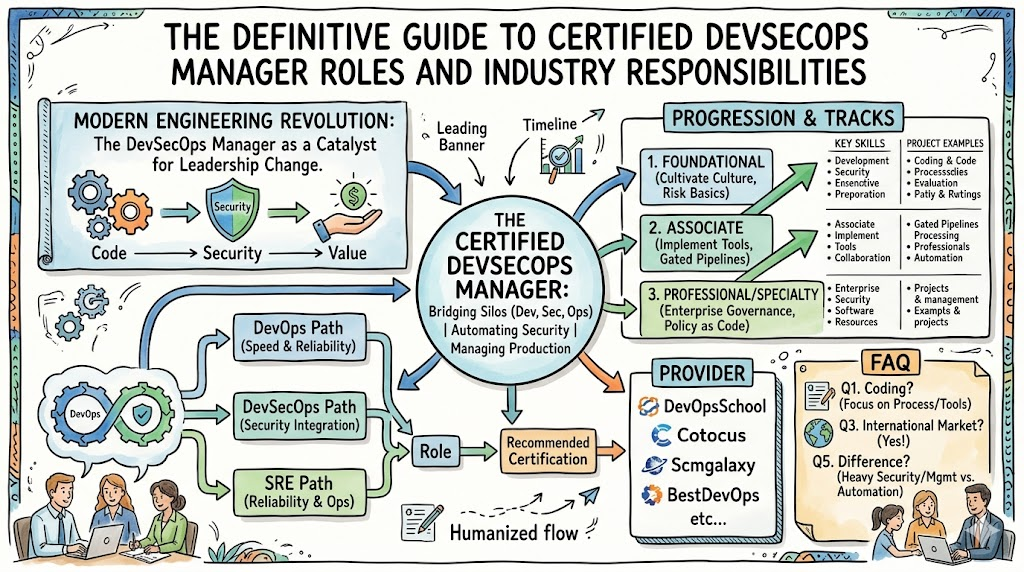
Securing the modern software supply chain requires a unique blend of technical oversight and cultural leadership. The Certified DevSecOps Manager program establishes the professional standard for individuals who wish to lead these complex transformations. By pursuing this credential through DevSecOpsSchool, you acquire the strategic framework necessary to manage risk without sacrificing development speed. This guide empowers engineers and managers to navigate their career progression by understanding how security integrates into cloud-native and platform engineering roles. We provide this roadmap to help you make informed decisions that align with the high-velocity demands of today’s tech industry.
Modern engineering environments no longer treat security as a separate silo or a final hurdle before production. Instead, organizations demand leaders who can bake protection into every automated build and deployment. This guide explores the value of formalizing your expertise, the difficulty of the curriculum, and the tangible career impact of mastering DevSecOps management. We map these certifications to real-world roles to ensure you choose a path that fits your professional goals. Whether you lead a small DevOps squad or a global engineering department, the insights here will help you master the art of secure software delivery.
What is the Certified DevSecOps Manager?
The Certified DevSecOps Manager represents a strategic commitment to governing secure software lifecycles in high-speed environments. This program exists because traditional security management fails to keep pace with the rapid cycles of CI/CD and microservices architecture. It prioritizes production-grade mastery over static theory, teaching candidates how to orchestrate security tools, people, and processes effectively. You learn to move beyond simple vulnerability scanning and start building resilient systems that defend themselves.
This certification aligns with modern enterprise workflows by emphasizing the governance of automated security gates. It focuses on how managers can implement “Security as Code” across the entire organization to ensure consistency and compliance. By earning this title, you prove your ability to manage the delicate balance between rapid innovation and risk mitigation. It validates that you can lead a team through the technical and cultural shifts required for a successful DevSecOps adoption.
Who Should Pursue Certified DevSecOps Manager?
Engineering leads and senior developers who want to transition into strategic management roles will find this path most beneficial. Site Reliability Engineers (SREs), cloud architects, and platform leads who manage infrastructure automation also gain immense value from this curriculum. It provides the necessary oversight for security professionals who need to understand how development teams operate in an agile world. We also recommend this program for technical project managers who oversee the delivery of cloud-native applications.
This certification carries significant weight for professionals working in both the Indian tech sector and the global market. While experienced engineers use it to formalize their leadership skills, beginners use it to map out a clear career trajectory in the security domain. If you find yourself responsible for the safety of a production environment or the output of a dev team, you fit the target profile. Managers who need to justify security budgets and tool selections to stakeholders will also find the governance modules indispensable.
Why Certified DevSecOps Manager is Valuable
Enterprise adoption of DevSecOps continues to accelerate, creating a massive demand for managers who truly understand the discipline. This certification offers longevity because it teaches fundamental principles of risk management that remain relevant even as specific tools change. You gain the ability to evaluate new technologies and integrate them into a secure workflow, ensuring your skills stay current in a shifting landscape. It moves you from a tactical role to a strategic one, increasing your influence within the organization.
The return on your time investment manifests through faster career progression and the ability to command higher compensation packages. Companies prioritize hiring certified managers who can reduce the cost of security breaches through proactive prevention strategies. By mastering this domain, you become a business enabler who protects the company’s reputation while maintaining its competitive edge. It turns security into a competitive advantage rather than a bottleneck, making you an essential asset to any leadership team.
Certified DevSecOps Manager Certification Overview
DevSecOpsSchool delivers the program through an official course structure that emphasizes practical, hands-on learning. You access all materials and assessments on the devsecopsschool.com hosting platform, which provides a comprehensive environment for mastering manager-level skills. The certification uses a rigorous assessment approach that combines conceptual exams with real-world scenarios to test your decision-making abilities. It ensures that you don’t just memorize terms but actually understand how to apply them in a production environment.
The ownership of the certification lies with industry veterans who ensure the content reflects current enterprise practices and compliance standards. It follows a modular structure that allows you to progress through different domains of security management at your own pace. This practical focus ensures that you emerge with the confidence to lead a team through a full-scale DevSecOps implementation. You gain a verified credential that signals your mastery of governance, ROI analysis, and organizational change to the entire industry.
Certified DevSecOps Manager Certification Tracks & Levels
The program organizes learning into a logical hierarchy that supports long-term career growth. You start with the Foundational level to establish core concepts, then move to the Associate and Professional levels as your expertise deepens. Each level introduces more complex management challenges, moving from tool integration to organizational strategy and global compliance. This tiered approach allows you to build a specialized profile that fits your current job role while preparing you for future promotions.
Specialization tracks allow you to align your certification with specific domains like SRE, FinOps, or Platform Engineering. You can choose to focus on the technical implementation of security gates or the broader strategic governance of an entire engineering department. These tracks show recruiters exactly where your strengths lie and how you can add value to their specific organizational structure. By moving through these levels, you create a clear roadmap for your professional development in the DevSecOps space.
Complete Certified DevSecOps Manager Certification Table
| Track | Level | Who it’s for | Prerequisites | Skills Covered | Recommended Order |
| Security Lead | Foundational | New Managers | Basic IT Skills | Culture, SDLC, Principles | 1 |
| Engineering | Associate | Senior Devs | 2+ Years Experience | Tooling, CI/CD Security | 2 |
| Strategy | Professional | Directors/CTOs | 5+ Years Experience | ROI, Governance, Policy | 3 |
| Cloud Defense | Specialty | Cloud Architects | Cloud Knowledge | IaC Security, Containers | Optional |
| Compliance | Specialty | Audit Leads | Risk Knowledge | Audit Automation, Policy | Optional |
Detailed Guide for Each Certified DevSecOps Manager Certification
Foundational Level
Certified DevSecOps Manager – Foundation
What it is
This certification validates your understanding of the core DevSecOps mindset and the “Shift Left” philosophy. It ensures you know how to integrate security into the development process without disrupting the team’s workflow.
Who should take it
Project managers, junior engineers, and stakeholders who need to understand the basic mechanics of secure automation should start here. It serves as the perfect entry point for those transitioning from traditional IT roles into DevOps leadership.
Skills you’ll gain
- Mastery of the DevSecOps manifesto and core cultural principles.
- Identifying security vulnerabilities within the standard software lifecycle.
- Basic knowledge of automated security testing categories.
- Communicating the business value of DevSecOps to non-technical teams.
Real-world projects you should be able to do
- Audit a basic CI/CD pipeline for obvious security gaps.
- Draft a security awareness roadmap for a small development team.
- Categorize common web vulnerabilities and suggest remediation steps.
Preparation plan
- 7–14 days: Review the official study guides and complete introductory video modules.
- 30 days: Engage with practice quizzes and attend a foundational workshop.
- 60 days: Apply the concepts to a mock project and review successful industry case studies.
Common mistakes
- Treating security as a tool-only problem instead of a cultural shift.
- Ignoring the impact of security gates on the developer experience.
Best next certification after this
- Same-track option: Associate Level DevSecOps Manager.
- Cross-track option: DevOps Foundation.
- Leadership option: Certified Scrum Master.
Associate Level
Certified DevSecOps Manager – Associate
What it is
The Associate level validates your ability to technically implement and manage security tools within an automated pipeline. It proves you can configure security gates that provide high-value feedback to development teams in real-time.
Who should take it
Mid-level DevOps engineers and security analysts who handle the daily technical operations of the build system should pursue this. You should possess a working knowledge of containers, Linux, and common CI tools like Jenkins.
Skills you’ll gain
- Configuring SAST, DAST, and SCA tools within a pipeline.
- Managing container security and automated image scanning.
- Implementing secrets management and environment protection.
- Setting up automated compliance checks using Policy as Code.
Real-world projects you should be able to do
- Build a fully automated secure pipeline for a microservice.
- Configure a private container registry with integrated vulnerability scanning.
- Implement a centralized secrets management solution for a dev team.
Preparation plan
- 7–14 days: Intensive hands-on labs focusing on specific security tool integrations.
- 30 days: Build and troubleshoot a complete end-to-end secure build process.
- 60 days: Optimize scan times and refine the alert system to reduce false positives.
Common mistakes
- Failing to secure the build environment itself while focusing on the code.
- Implementing too many security gates at once, causing team frustration.
Best next certification after this
- Same-track option: Professional Level DevSecOps Manager.
- Cross-track option: Cloud Security Associate.
- Leadership option: Technical Lead Certification.
Professional/Specialty Level
Certified DevSecOps Manager – Professional
What it is
The Professional level serves as the ultimate validation for senior managers and architects who oversee global security strategies. It proves you can manage budgets, ROI, and organizational change at an enterprise scale.
Who should take it
Senior leads, Directors of Engineering, and CTOs who hold responsibility for organizational policy and long-term technical strategy should take this. It requires deep expertise in both technical systems and business management.
Skills you’ll gain
- Designing and enforcing enterprise-grade security governance models.
- Calculating the ROI of security toolchains and automation efforts.
- Leading cross-functional teams through complex cultural transformations.
- Managing global compliance standards like SOC2 and GDPR through automation.
Real-world projects you should be able to do
- Develop a three-year DevSecOps strategy for a large organization.
- Conduct a comprehensive cost-benefit analysis for security tool consolidation.
- Design a global vulnerability management program with automated remediation.
Preparation plan
- 7–14 days: Review high-level governance frameworks and global compliance laws.
- 30 days: Focus on leadership scenarios and conflict resolution strategies for teams.
- 60 days: Draft a complete enterprise security policy and conduct a mock ROI review.
Common mistakes
- Focusing on “Zero Risk” instead of “Manageable Risk” for the business.
- Failing to align security goals with the company’s revenue objectives.
Best next certification after this
- Same-track option: Principal DevSecOps Architect.
- Cross-track option: FinOps Professional.
- Leadership option: Executive Leadership Program.
Choose Your Learning Path
DevOps Path
The DevOps path focuses on the engineering mechanics of high-velocity delivery. You learn how to treat security as a quality metric, ensuring that every code commit undergoes automated testing before reaching production. This path is ideal for managers who want to build seamless, self-service platforms that empower developers to work safely and quickly.
DevSecOps Path
This core path addresses the specific challenges of integrating rigorous security into agile environments. You prioritize the “Security” aspect of the lifecycle, learning how to manage technical debt and vulnerability remediation at scale. It serves as the primary choice for those aiming for the Manager designation in a security-focused role.
SRE Path
The SRE path views security through the lens of system reliability and uptime. You learn to manage security incidents as reliability failures and use observability tools to detect anomalies in real-time. This path suits managers who oversee large-scale production environments where availability is the top priority for the business.
AIOps Path
This path explores the use of artificial intelligence to enhance IT operations and security monitoring. You learn to use machine learning models to identify patterns in logs and predict potential threats before they manifest. It represents the next frontier for managers who want to lead high-maturity, automated engineering organizations.
MLOps Path
The MLOps path focuses on the unique security requirements of machine learning pipelines. You learn to secure the data supply chain and protect against model poisoning while maintaining compliance with ethical standards. This is essential for leaders in organizations that are heavily investing in AI-driven products and services.
DataOps Path
DataOps focuses on the secure and efficient management of data flows across the organization. You learn how to apply DevSecOps principles to data engineering, ensuring that sensitive information remains protected during analysis and processing. This path is vital for managers in sectors like finance, healthcare, and research.
FinOps Path
The FinOps path addresses the financial management of cloud and security resources. You learn how to optimize your security toolchain for cost-effectiveness and how to prevent waste in cloud security spending. This skill is increasingly valuable for managers who need to prove the economic value of their department.
Role → Recommended Certified DevSecOps Manager Certifications
| Role | Recommended Certifications |
| DevOps Engineer | Associate Level, Cloud Security Specialty |
| SRE | Associate Level, SRE Foundation |
| Platform Engineer | Professional Level, IaC Security Specialty |
| Cloud Engineer | Associate Level, Infrastructure Specialty |
| Security Engineer | Professional Level, Advanced Governance |
| Data Engineer | Associate Level, DataOps Specialty |
| FinOps Practitioner | Foundational Level, FinOps Specialty |
| Engineering Manager | Professional Level, Strategic Leadership |
Next Certifications to Take After Certified DevSecOps Manager
Same Track Progression
Deepening your expertise in the DevSecOps domain involves pursuing advanced architectural roles. You might focus on Zero Trust networking or advanced container security to solidify your standing as a technical authority. These certifications prove that you can not only manage a team but also design the core systems that protect the entire enterprise.
Cross-Track Expansion
Broadening your skills into adjacent fields like FinOps or AIOps makes you a more versatile leader. By understanding how security impacts cloud costs and automated operations, you provide more holistic value to the business. This cross-training prepares you for high-level roles like VP of Engineering or Chief Technology Officer where a wide perspective is required.
Leadership & Management Track
If you wish to move into executive leadership, focus on certifications that emphasize business strategy and financial management. Pursue credentials that teach you how to align technical roadmaps with the organization’s long-term commercial goals. These skills, combined with your technical background, create a powerful profile for leading major digital transformations at the C-suite level.
Training & Certification Support Providers for Certified DevSecOps Manager
- DevOpsSchool
This institution provides comprehensive training that bridges the gap between technical theory and practical application. Their curriculum focuses on hands-on labs and real-world case studies, ensuring that you gain the skills needed for the modern workplace. They offer extensive support for all certification levels, making them a top choice for aspiring managers worldwide. - Cotocus
As a specialized consultancy, this provider focuses on high-end technical training for global enterprises. They help teams navigate the complexities of cloud-native security and automated governance through expert-led workshops. Their approach emphasizes the intersection of people and technology, providing leaders with the tools to drive organizational change effectively. - Scmgalaxy
This provider operates as a major community hub, offering a wealth of technical resources and community-driven learning modules. Their training programs emphasize the use of open-source tools and community best practices for secure software delivery. They are an excellent resource for those who prefer a collaborative and knowledge-sharing approach to their professional development. - BestDevOps
This provider focuses on curated learning paths that help professionals reach their career goals in the shortest time possible. They offer targeted coaching for the DevSecOps Manager program, ensuring that candidates are well-prepared for both the exam and the job. Their instructors are active industry practitioners who bring current insights into every training session. - devsecopsschool.com
The official portal for DevSecOps education provides a seamless and accessible learning experience for professionals. It hosts a massive library of video content, documentation, and practice labs specifically tailored to the Manager level curriculum. The platform’s self-paced nature makes it ideal for busy managers who need to balance their studies with a full-time career. - sreschool.com
This provider focuses on the crucial link between system reliability and security, making it the ideal choice for SREs. Their training programs teach you how to maintain high availability while implementing rigorous security gates. They emphasize the use of observability and automated remediation to build systems that are not only secure but also incredibly resilient. - aiopsschool.com
As a leader in AI-driven operations training, this institution provides the knowledge needed to lead the next generation of engineering teams. Their courses explore the use of machine learning to automate complex security and operations tasks. For a DevSecOps manager, this provider offers the specialized knowledge needed to stay ahead in an increasingly automated industry. - dataopsschool.com
This provider addresses the growing need for secure data management within the DevOps lifecycle. Their curriculum focuses on the governance, privacy, and protection of data as it flows through automated pipelines. Managers who complete their programs are well-equipped to handle the security challenges of modern, data-heavy organizations. - finopsschool.com
Focusing on the financial side of the cloud, this provider helps managers optimize their security and operations spending. They provide the frameworks necessary to manage cloud budgets effectively without sacrificing safety. Their training is essential for leaders who need to demonstrate the economic value of their DevSecOps initiatives to the business.
Frequently Asked Questions
1. Does the exam focus more on technical skills or management theory?
The exam requires a balanced understanding of both, testing your ability to lead teams while understanding the technical tools they use daily.
2. How long does the certification remain valid?
Certifications generally stay valid for two to three years, after which you must renew them to prove you are current with technology.
3. Is there a prerequisite for the Professional level?
We highly recommend several years of technical experience and the completion of the Associate level before attempting the Professional certification.
4. Can I take the exam from my home?
Yes, the testing platform provides secure, proctored online exams that allow you to get certified from anywhere in the world.
5. How much time should I dedicate to studying?
Most candidates spend about 10 hours a week over a two-month period to fully grasp the manager-level concepts and labs.
6. Does the course include access to live labs?
Yes, the program provides cloud-based labs where you can practice configuring security tools in a safe, simulated environment.
7. Are the instructors available for questions during the course?
The platform offers community forums and instructor support to help you through any difficult concepts or technical challenges.
8. Is this certification recognized by large enterprises?
Major tech companies and global enterprises highly value this credential when hiring for DevOps and security leadership positions.
9. Can this certification help me switch from QA to Security?
Absolutely, the principles of automated testing in DevSecOps share many similarities with Quality Assurance, making it a natural transition.
10. What is the format of the exam?
The exam typically consists of multiple-choice questions followed by practical scenarios where you must suggest management solutions.
11. Is there a community for certified managers?
Yes, you gain access to an exclusive network of certified professionals where you can share insights and career opportunities.
12. Does the curriculum cover the use of AI in security?
The more advanced tracks include modules on how AIOps and machine learning are currently transforming the DevSecOps industry.
FAQs on Certified DevSecOps Manager
1. Practical questions often arise regarding the cultural side of the role; how does this course help?
The curriculum provides specific frameworks for managing the “People” aspect of the DevSecOps transition, focusing on empathy and shared goals. You learn how to resolve friction between development teams and security auditors by creating win-win scenarios through automation. The program teaches you how to build a culture where security is seen as an enabler of speed rather than a barrier to release.
2. Does the program address the security of the automated tools themselves?
Yes, a major focus of the Associate and Professional levels is “Securing the Pipeline,” which ensures your automation tools don’t become a liability. You learn how to harden Jenkins, GitLab, and other CI/CD servers against unauthorized access and malicious configuration changes. This ensures that the very systems meant to protect your software are not used as an entry point for attackers.
3. How does a manager justify the ROI of security automation to the board?
The Professional level teaches you how to quantify security outcomes using metrics like Mean Time to Remediate (MTTR) and Lead Time. You learn to translate technical risks into financial impacts, helping executives understand the cost savings associated with preventing data breaches. This data-driven approach allows you to secure the budget and executive support needed for your long-term security initiatives.
4. Can this certification help with managing remote or distributed engineering teams?
Managing security in a remote environment requires a heavy reliance on automated governance and self-service tools, which are core themes of this course. You learn how to enforce security policies consistently across global teams without needing physical oversight or manual sign-offs. This makes the certification incredibly relevant for leaders managing the modern, distributed workforce.
5. What role does “Policy as Code” play in the manager’s daily responsibilities?
Policy as Code allows a manager to set global security standards that are automatically enforced across every project in the organization. The course teaches you how to define these policies in a machine-readable format, reducing the need for manual audits and human error. This frees you up to focus on high-level strategy while the system ensures that every build meets your security requirements.
6. How does the certification handle the security of third-party dependencies?
Supply chain security is a massive part of the curriculum, focusing on Software Bill of Materials (SBOM) and automated library scanning. You learn how to manage the risk of open-source software by implementing gates that block vulnerable dependencies before they ever reach production. This ensures that the code your team didn’t write is just as secure as the code they did.
7. Does the training cover the legal aspects of data privacy?
Yes, the strategy level includes modules on global privacy laws like GDPR and HIPAA, focusing on how to automate the compliance side of these regulations. You learn how to ensure your engineering processes meet legal standards without requiring a lawyer to review every code change. This integration of legal and technical oversight is a key skill for any modern security manager.
8. How do I balance developer velocity with rigorous security checks?
The course emphasizes the creation of “Golden Paths” where security is baked into the developer’s existing tools, like their IDE or their pull request workflow. You learn to provide high-quality feedback that helps developers fix issues quickly rather than just blocking their work. This collaborative approach ensures that security stays fast enough to keep up with the demands of the business.
Final Thoughts: Is Certified DevSecOps Manager Worth It?
Investing in your professional development through this certification is a decisive step toward becoming a modern technical leader. As the gap between development and security continues to close, the industry rewards those who can navigate both worlds with confidence. This program doesn’t just give you a credential; it provides the mental models needed to lead high-performing teams through the most challenging security landscapes. You gain the ability to speak the language of the coder, the operator, and the executive, making you a bridge for organizational success. The real value lies in the shift from being a reactive problem-solver to a proactive architect of secure systems. You move from a position where you are constantly fighting fires to one where you have designed systems that prevent them from starting. For any professional in India or abroad who aims to sit at the intersection of technology and strategy, this path offers the most direct route to the C-suite. My honest advice is to embrace this challenge, as the demand for managers who can truly master DevSecOps will only grow in the coming years.